
Losing a tooth is something most adults hope to avoid, but for many people, it happens. Whether it’s from an accident, advanced decay, gum disease, or an extraction that was long overdue, a missing tooth leaves behind more than just a gap in your smile. And when that gap goes unaddressed, the consequences can quietly compound over months and years in ways that are far more serious than most people realize.
It’s tempting to put off dealing with a missing tooth especially if it’s toward the back of your mouth where nobody can see it. “It doesn’t bother me,” is something we hear often. “I’ll deal with it eventually.” But the truth is, your mouth doesn’t wait for you to be ready. The moment a tooth is lost, your body begins responding in ways that can affect your oral health, your facial structure, and even your overall well-being.
At SmileCare Dental, we want every patient to understand what’s at stake when a missing tooth is left untreated and to know that there are excellent, accessible solutions available. This guide breaks it all down so you can make the most informed decision for your health.
How Losing One Tooth Impacts the Rest of Your Mouth
To understand why a missing tooth matters so much, it helps to think about how your teeth function as an interconnected system. Every tooth in your mouth has a job. Together, they support each other structurally, distribute the forces of chewing evenly, and hold each other in proper alignment.
When one tooth is removed from that system and not replaced the balance is disrupted. The remaining teeth begin to shift, tilt, and drift toward the open space over time. The opposing tooth (the one that used to bite against the missing tooth) can begin to over-erupt, growing downward or upward into the gap. What starts as a single missing tooth can set off a chain reaction that affects your entire bite.
This process happens gradually, which is exactly why it’s so easy to dismiss in the early days and weeks after a tooth is lost. But make no mistake it is happening.
The Consequences of Ignoring a Missing Tooth
Here is a detailed look at what happens in your mouth and beyond when a missing tooth goes untreated.
1. Bone Loss in the Jaw
This is perhaps the most significant and least visible consequence of a missing tooth and it begins almost immediately. Your jawbone is kept strong and dense by the stimulation it receives through the roots of your teeth when you chew. Every bite, every chew, every time your teeth come together, your tooth roots send tiny mechanical signals into the bone that tell it to keep regenerating.
When a tooth is gone, that stimulation stops in that area of the jaw. Without it, the body essentially interprets the bone as unnecessary and begins to resorb it breaking it down and redistributing the calcium elsewhere. Studies show that the jawbone can lose up to 25% of its width in the first year alone after a tooth is lost, and bone loss continues for years afterward.
This has cascading consequences. Bone loss affects the stability of neighboring teeth, changes the shape of your face (leading to a sunken or prematurely aged appearance), and can make future tooth replacement options significantly more complex and expensive. Once bone is lost, replacing it requires bone grafting procedures before an implant can be placed.
2. Shifting and Drifting of Surrounding Teeth
Teeth maintain their position partly because of the pressure exerted by neighboring teeth on both sides. Remove a tooth, and that lateral support vanishes. The adjacent teeth will gradually tilt and drift into the open space sometimes significantly over the months and years that follow.
At the same time, the tooth directly above or below the gap (the opposing tooth) no longer has anything to bite against. Without that counter-pressure, it begins to super-erupt gradually moving out of the jawbone and into the empty space. This can happen slowly enough that you don’t notice it on a day-to-day basis, but the cumulative effect over time is significant misalignment throughout your bite.
Correcting this misalignment later often requires orthodontic treatment in addition to tooth replacement a much longer, more expensive process than simply replacing the tooth when it was first lost.
3. Difficulty Chewing and Changes to Your Diet
Your teeth are designed to work together to break down food efficiently. Even one missing tooth especially a molar can significantly reduce your chewing efficiency. Most people compensate by shifting how they chew, favoring one side of the mouth over the other or avoiding certain foods altogether.
Over time, this compensation puts undue stress on the remaining teeth and jaw joints. And the dietary changes can be more significant than they appear on the surface: people with missing teeth often unconsciously eliminate harder, crunchier foods like raw vegetables, whole fruits, and lean proteins that are important for good nutrition. The connection between tooth loss and nutritional deficiency is well-documented in dental research.
4. Increased Risk of Tooth Decay and Gum Disease
As surrounding teeth shift and tilt into the gap left by a missing tooth, new hard-to-clean angles and overlaps are created. Food and bacteria become more difficult to remove with regular brushing and flossing, leading to an elevated risk of cavities and gum disease in the teeth around the gap.
The exposed gum tissue and bone in the gap itself can also become irritated and more susceptible to infection. What began as one missing tooth can gradually contribute to the deterioration of the oral health of multiple surrounding teeth a compounding problem that becomes more expensive and difficult to address the longer it goes on.
5. TMJ Problems and Jaw Pain
Your temporomandibular joint (TMJ) the hinge joint that connects your jaw to your skull is exquisitely sensitive to changes in bite balance. When teeth shift and your bite becomes uneven due to a missing tooth, extra stress is placed on the TMJ and the surrounding muscles.
Over time, this can manifest as chronic jaw pain, clicking or popping in the jaw joint, headaches (particularly in the temples), earaches, and neck and shoulder tension. TMJ disorders are notoriously difficult and costly to treat and an unbalanced bite caused by a missing tooth is a common contributing factor.
6. Changes to Your Facial Appearance
The jawbone provides the structural foundation that supports the lower portion of your face. As bone resorption progresses following tooth loss, the face can begin to visibly change shape — particularly around the cheeks, lips, and chin. The lower face may take on a sunken or collapsed appearance that makes a person look significantly older than their actual age.
This is not a vanity concern it is a genuine health outcome. The structural changes caused by jawbone loss can affect speech, chewing function, and the fit of any future dental restorations. And because bone loss is a one-way street without intervention, the changes become harder to reverse the longer they are allowed to progress.
7. Impact on Speech
Teeth play an important role in the production of clear speech. Missing front teeth in particular can cause noticeable changes to pronunciation particularly for sounds like “s,” “th,” “f,” and “v.” Even missing back teeth can subtly affect speech clarity. Many people who have lived with a missing tooth for years have adapted without realizing it, and don’t appreciate how much their speech has changed until after a tooth is replaced.
8. The Psychological and Social Toll
A missing tooth especially one that is visible when you smile or speak can have a real impact on self-confidence and quality of life. Research consistently shows that people who are unhappy with their smile smile less, make less eye contact, feel more self-conscious in social situations, and even hold back in professional settings. The psychological effects of tooth loss are often underestimated by people who haven’t experienced them firsthand.
Does It Matter Where the Missing Tooth Is?
A very common misconception is that a missing back tooth one that’s not visible when you smile is somehow less important than a missing front tooth. This is understandable from an aesthetic standpoint, but from a health perspective, it simply isn’t true.
Molars and premolars are the workhorses of your chewing system. They bear the majority of the force when you eat. Losing a molar has a profound effect on chewing efficiency, puts additional stress on the remaining teeth, and triggers the same bone loss process that occurs with any missing tooth often more significantly, because molars have larger, deeper roots that were providing more bone stimulation.
The bottom line: every missing tooth matters, regardless of its position in the mouth. The consequences are the same bone loss, shifting, increased risk of decay whether the gap is front and center or tucked away in the back.
Your Options for Replacing a Missing Tooth
The good news: modern dentistry offers excellent solutions for replacing missing teeth at a range of price points and complexity levels. The right option for you depends on how many teeth are missing, the health of your remaining teeth and jawbone, your budget, and your personal preferences. Here’s a clear overview of the main options:
Dental Implants
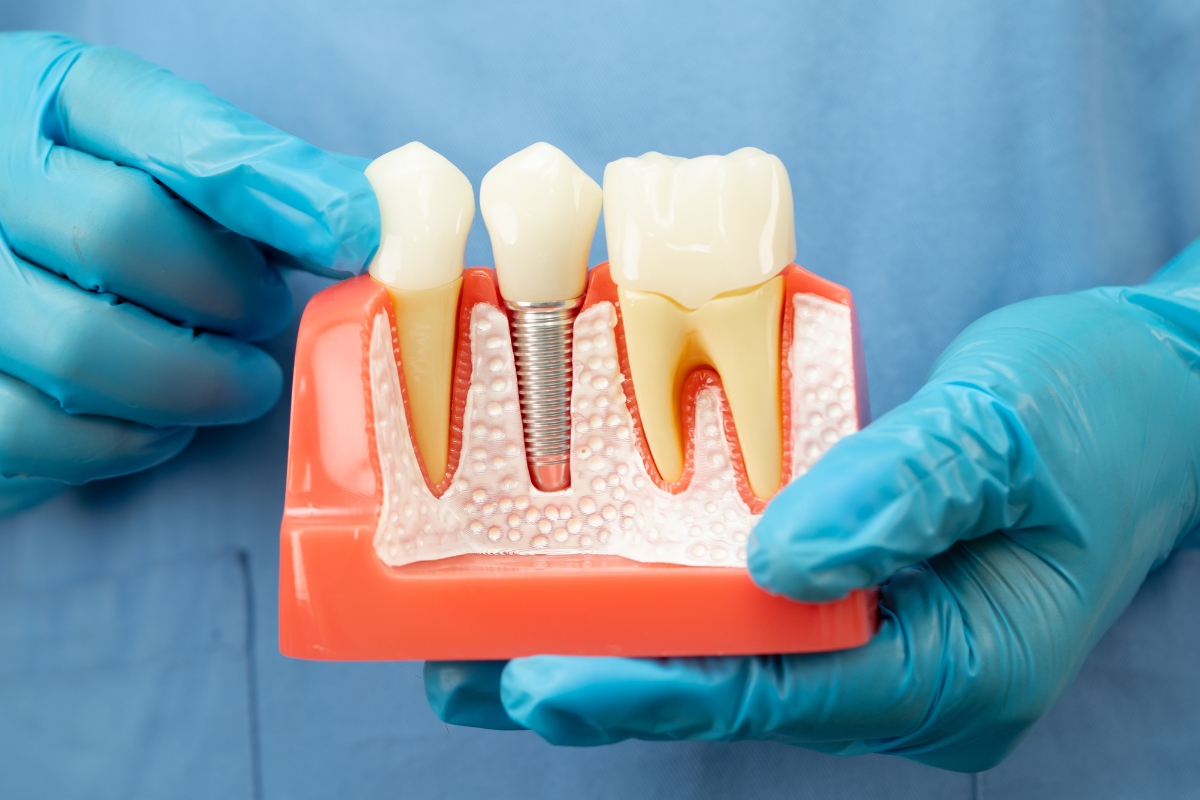
Dental implants are widely considered the gold standard for tooth replacement, and for good reason. A titanium post is surgically placed into the jawbone, where it fuses with the bone over several months in a process called osseointegration. Once integrated, a custom-made dental crown is attached on top, creating a replacement tooth that looks, feels, and functions just like a natural tooth.
Key advantages of dental implants:
- They stimulate the jawbone, preventing bone loss
- They are the only tooth replacement option that addresses bone resorption
- They do not affect neighboring teeth (unlike a bridge)
- They can last a lifetime with proper care
- They look and feel completely natural
The main considerations are cost (implants are the most expensive option upfront) and timeline (the full process typically takes several months). However, when you factor in durability and long-term oral health benefits, implants are often the most cost-effective choice over a lifetime.
Dental Bridges
A dental bridge literally “bridges” the gap left by a missing tooth by anchoring an artificial tooth (called a pontic) to the natural teeth on either side of the space. The neighboring teeth are fitted with dental crowns that hold the bridge firmly in place.
Bridges are a time-tested, effective solution that can be completed in two visits without surgery. They look and function well, and they restore the ability to chew and speak normally. The tradeoff is that the healthy neighboring teeth must be permanently altered to support the bridge, and bridges do not prevent the bone loss that occurs beneath the pontic over time.
Dentures
For patients missing multiple teeth, a removable partial denture is a non-invasive option. A denture is a custom-made appliance that clasps onto existing teeth and fills in the gaps with artificial teeth. It is removable for cleaning and sleeping.
Dentures are typically the most budget-friendly tooth replacement option. However, they are less stable than implants or bridges, can feel bulky or uncomfortable for some patients, and do not prevent bone loss in the jaw. They are best suited for patients who are not candidates for implants or bridges, or who need a more affordable interim solution.
Why Acting Sooner Is Always Better
If there’s one message we want every patient with a missing tooth to take away from this guide, it’s this: time works against you.
The longer a missing tooth is left untreated, the more bone is lost, the more surrounding teeth shift, and the more complex and expensive the eventual solution becomes. A patient who replaces a missing tooth promptly may be a straightforward candidate for an implant. That same patient, two years later with significant bone loss and shifted teeth, may now require bone grafting, orthodontic treatment, and a longer, more involved restoration process before an implant can even be placed.
Acting early is almost always the simpler, less expensive, and healthier choice. If cost is a concern, talk to your dental team about financing options many practices offer payment plans that make tooth replacement accessible without requiring a large upfront payment.
Frequently Asked Questions About Missing Teeth
How soon does bone loss start after a tooth is lost?
Bone resorption begins within the first few weeks after a tooth is lost and progresses most rapidly in the first year. Research shows that up to 25% of bone width can be lost within 12 months of tooth loss. This is why prompt evaluation and treatment planning are so important after losing a tooth.
Is it okay to leave a missing tooth if it’s in the back of my mouth?
No — the location of a missing tooth does not reduce its impact on your oral health. Back teeth (molars and premolars) bear most of the chewing load and have large roots that provide significant bone stimulation. Losing a back tooth triggers the same bone loss, shifting, and bite imbalance issues as losing a front tooth and in some ways can have a more significant functional impact because of the critical role molars play in chewing.
What is the best way to replace a missing tooth?
For most patients who are good candidates, a dental implant is the best long-term solution because it replaces the tooth root, prevents bone loss, and does not affect neighboring teeth. However, the best option for any individual depends on their overall health, the condition of their jawbone, how many teeth are missing, and their budget. A thorough consultation with your dentist will help determine the most appropriate path forward.
Can a missing tooth cause headaches?
Yes. When a missing tooth causes bite imbalance which it often does over time as surrounding teeth shift it places uneven stress on the jaw joints (TMJ) and surrounding muscles. This can contribute to chronic headaches, particularly tension headaches felt in the temples and around the jaw. Patients who experience headaches alongside a missing tooth should mention this to their dentist.
How long does it take to replace a missing tooth?
The timeline depends on the replacement option chosen. A dental bridge can typically be completed in two visits over two to three weeks. A dental implant involves a longer process generally three to six months from implant placement to final crown because of the time needed for the implant to integrate with the jawbone. Your dentist will outline a specific timeline at your consultation.
Missing a Tooth? Don’t Wait – Visit Our Fitchburg Dental Office Today.
A missing tooth is never just a cosmetic concern — it’s a health issue that deserves prompt attention. The longer you wait, the more complex and costly the solution becomes. The good news is that modern tooth replacement options are better than they’ve ever been, and our team at SmileCare Dental in Fitchburg is here to walk you through every option with clarity and care.
Whether you’re exploring dental implants, a bridge, or another solution, we’ll take the time to understand your situation and recommend the approach that best fits your health, your lifestyle, and your budget. No pressure. Just honest, expert guidance from a team that genuinely cares about your long-term health.
We proudly serve patients throughout Fitchburg and the surrounding communities of Leominster, Westminster, Lunenburg, and Gardner, MA.